
Film Cell Man
Sleep Paralysis Demons: Why the Bedroom Becomes a Haunted Place
What explains sleep paralysis demons? Follow the science, folklore and cinema of the waking mind, the motionless body and a presence in the bedroom.

The woman in Henry Fuseli’s The Nightmare cannot answer the creature sitting on her body. Her head falls backwards over the bed; the little figure above her seems almost proprietorial, as though it has acquired the room along with its occupant. Painted in 1781, the picture gives a frightening sensation a visible tenant. The Detroit Institute of Arts, which holds the painting, makes a useful distinction: this is an image of what the nightmare feels like, rather than simply what the sleeper sees. That difference opens a way into sleep paralysis, an experience in which the conviction that something is present can be as powerful as any identifiable face.[1]
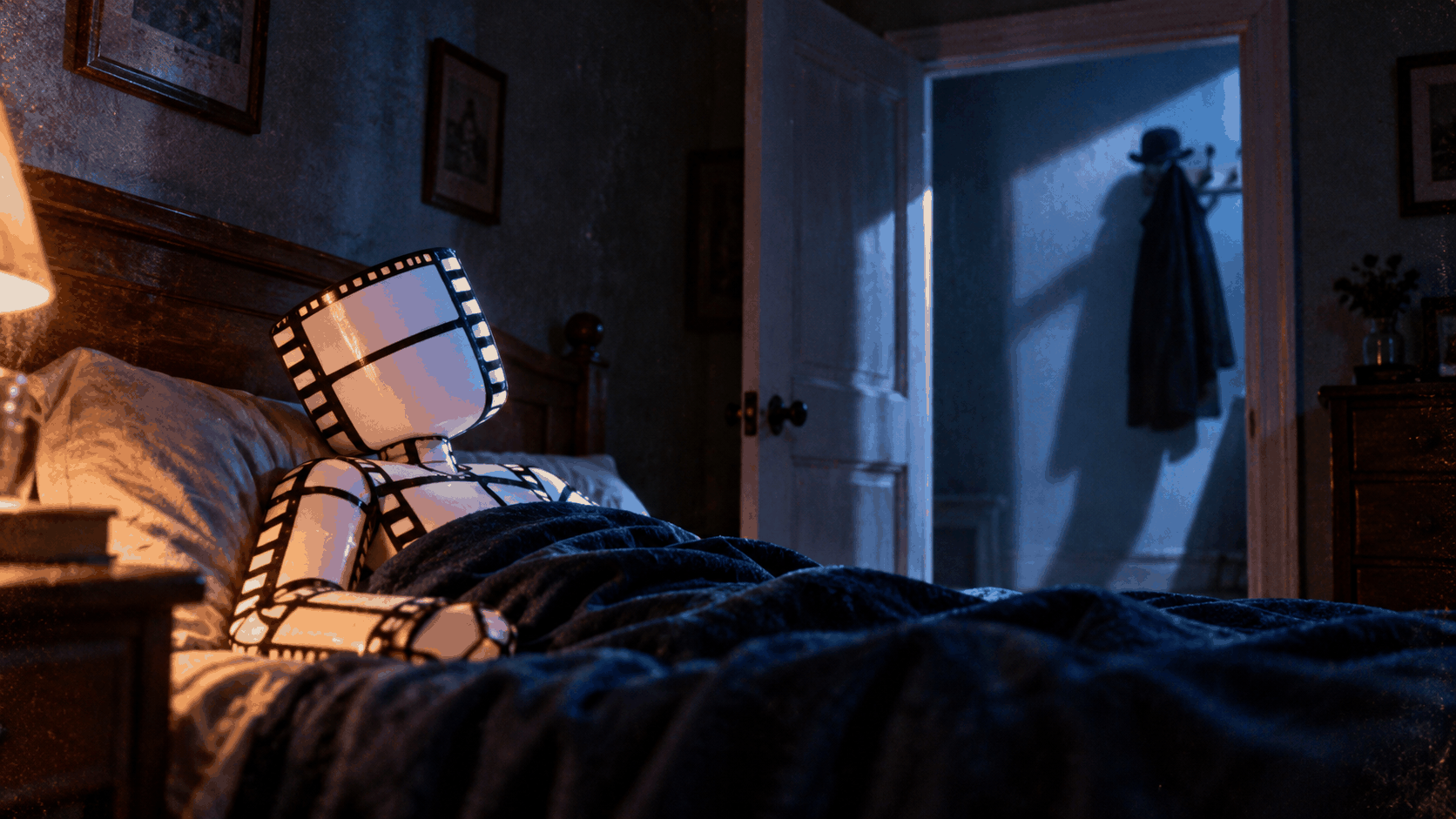
The waking mind and the body that will not follow
Sleep paralysis occurs at the boundary of sleep and waking, when awareness returns or develops while the muscular inhibition associated with rapid eye movement sleep remains. Someone may recognise the bedroom, try to speak or move, and find that the intended action does not happen. Dreamlike sights, sounds and bodily sensations can accompany this temporary immobility, though they do not have to. The familiar phrase sleep paralysis demons describes one frightening interpretation of some episodes. It is not a separate medical condition, and not everyone encounters a creature.[2]
Sleep and wakefulness are not always tidy, mutually exclusive compartments. In a 1992 laboratory study, Takeuchi and colleagues interrupted the sleep of sixteen participants and recorded episodes using polysomnography, which tracks several bodily signals during sleep. Their recordings captured features of waking alongside continuing muscle atonia. The study was small, but it supplied physiological evidence for a mixed state rather than relying entirely on stories told the following morning.[3]
That mixed state helps explain why the experience can feel so persuasive. A nightmare ordinarily loses its authority when the sleeper wakes and finds the bedroom intact. During paralysis, the bedroom may already seem available, so the place that should disprove the nightmare becomes its setting. A door, a curtain or the space beside a wardrobe can coexist with a sensation that does not belong there, and the person can neither move to investigate nor feel the reassurance of having clearly crossed from one state into another.
Isolated sleep paralysis means episodes that are not better explained by another disorder, such as narcolepsy, or by relevant substances or medications. It does not mean an episode happened only once. Recurrent isolated sleep paralysis involves repeated episodes with clinically significant distress. Brian Sharpless’s clinical review stresses assessing the experience and its consequences, rather than treating every recollection of temporary immobility as a disorder requiring treatment.[2]
The US National Heart, Lung, and Blood Institute describes narcolepsy as a disorder affecting the regulation of sleep and wakefulness, with pronounced daytime sleepiness among its features. Sleep paralysis and hallucinations around sleep can be part of that wider pattern.[22] An isolated frightening night cannot supply the whole diagnosis, so accompanying symptoms matter for assessment, not for self-diagnosis.
How common is it? There is no single percentage that can be detached from the population and question being studied. A 2011 systematic review by Sharpless and Jacques Barber combined thirty-five studies involving 36,533 people. It estimated lifetime experience at 7.6 per cent in general-population samples, compared with 28.3 per cent in students and 31.9 per cent in psychiatric patients. Those are historical pooled estimates, not a contemporary census, and they explain why conflicting prevalence figures circulate: different samples produce substantially different answers.[4]
Temporary paralysis around sleep is a recognised experience that can occur without a supernatural event. The harder question concerns its emotional form. Why should an interruption in movement feel like an interruption by somebody else?
How a sensation becomes an intruder
In research published in 1999, J. Allan Cheyne, Steve Rueffer and Ian Newby-Clark identified three broad clusters in reports accompanying sleep paralysis. One combined fear, a sensed presence and auditory or visual phenomena: the intruder. Another involved chest pressure, breathing discomfort and pain: the incubus. A third covered unusual bodily experiences such as floating, flying or seeming to leave the body. These were patterns in reported experiences, not obligatory stages or a definitive map of every episode.[5]
Sensation and interpretation can become entangled. Pressure may feel like weight; weight may suggest a body; a body that holds someone down suggests a will. This is one way to understand the appeal of an assailant narrative, not a proven sequence. The person may instead hear a sound without seeing anything, feel an undefined presence, or experience immobility without a threatening figure at all. The most memorable account is not necessarily the most representative.
Research on sensed presence outside sleep offers a limited comparison. In 2014, Olaf Blanke and colleagues studied neurological patients and used a robotic apparatus to introduce conflicts between movement and sensory feedback in healthy participants. Under experimental conditions, some participants experienced a presence nearby. The work showed that disturbed processing of signals associated with one’s own body can contribute to the impression of another person. It did not reproduce every feature of sleep paralysis.[6]
The feeling that somebody occupies a space need not begin with a clearly seen somebody. This reverses the usual logic of a ghost story, in which a witness sees a figure and concludes that someone is there. In some accounts, the certainty comes first and the figure supplies a form for it. That describes a possible vulnerability of perception, not a lying witness.
Nor should the word hallucination be taken as a verdict on a person’s wider mental health. The NHS distinguishes sleep paralysis from ordinary waking life and describes its characteristic sensations as temporary. A person who reports something terrifying at the moment of waking has described a sleep event, which alone does not establish a psychiatric diagnosis.[7] Dismissing the report can close off the conversation that would clarify when it happens, how long it lasts and what else is affecting sleep.
The bedroom also gives the experience an unusual intimacy. Fear in an unfamiliar place can be attributed to the place. Fear in one’s own bed violates the expectation that this is where vigilance ends. A threatening shape need not be elaborate to do that. Its effect may lie in its position, its apparent proximity and the sleeper’s inability to change the distance between them.
The Old Hag, kanashibari and the limits of a world map
Newfoundland’s Old Hag tradition gives that predicament a name. In a 1978 paper, Robert Ness described a combination of paralysis and hallucinations traditionally understood as an attack by the Old Hag, and approached it through a biocultural interpretation.[8] Folklorist David Hufford subsequently made such experiences central to The Terror That Comes in the Night. His work takes seriously the possibility that an extraordinary bodily experience helps generate supernatural belief, rather than assuming that a pre-existing story manufactured the experience.[9]
The choice of starting question matters. If a researcher begins by asking why people repeat an irrational legend, the answer is likely to concern credulity. If the question is what happened to a person who later adopted the legend’s language, different evidence becomes relevant. The name may arrive after the fear. A community’s account can make a bewildering event recognisable even when its explanation differs from that of sleep medicine.
Japan provides another example of a named experience that is not a uniform belief. In a 1987 questionnaire study, Kazuhiko Fukuda and colleagues examined kanashibari among 635 college students. About forty per cent reported at least one episode. Roughly half of those who had experienced it recalled physical or psychological stress, or disturbance to their sleep-wake cycle, beforehand.[10] The study supports the presence of a recognisable experience in that sample. It does not establish that forty per cent of Japan holds one supernatural belief, or that stress caused each reported episode.
A map assigning one monster to each country turns a regional tradition into a national consensus and a reported sensation into a fixed icon. People living in the same place can use medical, religious, familial and popular-cultural explanations at different moments. The same word can function as a diagnosis, a remembered warning, a joke or the nearest available description. Knowing a name is different from believing in the being associated with it.
Research in Istanbul makes that difference clear. A study of fifty-nine university students who had experienced sleep paralysis found that eighty-eight per cent named karabasan when asked about a term for the experience. Seventeen per cent thought a supernatural creature might have caused their own episode. Familiarity was far more widespread than endorsement. The sample was small, non-random, largely urban and predominantly female, so the findings should not be read as a survey of Turkey as a whole.[11]
Selection is a further problem. Recruiting people who already report a phenomenon helps researchers examine its character, but it cannot establish how many people in the wider population experience it. Translation also matters: a questionnaire has to make the event recognisable without supplying a creature for participants to report.
The same caution applies to Egyptian and Danish comparisons. Jalal and colleagues compared people with prior sleep-paralysis experience in Cairo and Copenhagen, alongside students at the American University in Cairo. Supernatural explanations varied between the groups; forty-eight per cent of the general Egyptian sample attributed the experience to jinn. The university group differed from the other Egyptian sample, a reminder that differences within a country matter alongside differences between countries.[12]
These findings make the cultural question more demanding. What account was available before the episode? Which account was adopted afterwards? Did it make the experience easier to discuss, or more alarming? A convincing study has to distinguish those possibilities, and a convincing essay should preserve them.
What fear remembers
Trauma complicates the relationship between sensation and meaning. In a 2005 study of one hundred Cambodian refugees receiving psychiatric care, Devon Hinton and colleagues found sleep paralysis in the previous year among forty-two participants. Those reporting it also described panic during episodes. The researchers explored ghost-related interpretations and connections between the experiences and trauma. This was a clinical refugee sample with particular histories and needs, not a prevalence estimate for all Cambodians or all refugees.[13]
A tradition should not be blamed for the suffering of people who have survived violence and displacement, and traumatic experience should not be reduced to background colour for a ghost story. The relevant question is how an episode is lived by this person, with this history, in these circumstances.
A systematic review by Dan Denis, Christopher French and Alice Gregory, published in 2018, examined forty-two studies of variables associated with sleep paralysis. Associations included disrupted sleep, anxiety-related measures, stress and trauma; the review also identified substantial variation in definitions and assessment. It does not support the neat conclusion that anxiety always produces paralysis, or that paralysis invariably produces trauma. Much of the literature cannot determine the direction of an association.[14]
Someone who fears going to sleep is not failing to understand a fact. They may understand the mechanism and still dread its recurrence. A scientific account can answer whether a creature was present without immediately changing the remembered helplessness, and expecting otherwise makes reassurance sound like an instruction to stop having an emotion.
A nightmare, a night terror and sleep paralysis are different events. The NHS explicitly distinguishes an inability to move or speak at sleep onset or awakening from night terrors.[15] A clinician needs the timing, the experience and the surrounding symptoms, rather than the most dramatic label.
Relief can begin with a more accurate description, but accuracy should not become a contest over whose vocabulary is permitted. A person might call the event a visitation while also noticing that it follows disrupted nights. Listening for the pattern does not require endorsing the supernatural conclusion, and respecting a belief does not require a health professional to withhold an evidence-based explanation.
The long afterlife of the night visitor
European incubus and succubus traditions placed nocturnal assault within accounts of supernatural beings and sexual threat. Their histories should not be flattened into retrospective medical diagnoses. Some old descriptions resemble sleep paralysis; others belong to theological argument, literary invention or wider beliefs about dreams. A likeness of imagery is a reason to investigate, not permission to declare that every historical demon was a misunderstood sleep disorder.[16]
Literature preserves the ambiguity. In the Queen Mab speech in Romeo and Juliet, Mercutio moves from intricate descriptions of dreams to a hag pressing upon women lying on their backs. Romeo interrupts him, and the conversation turns to the insubstantiality of dreams.[21] The passage brings bodily pressure, sexuality and imagination into the same verbal space without becoming a case report about Shakespeare or his characters.
The material record shows how firmly the pressure of the night could acquire a figure. Wellcome Collection preserves and discusses imagery and writing associated with the incubus, including John Bond’s 1753 An Essay on the Incubus, or Night-mare. Bond’s title itself joins a named visitor to an experience. Historical attempts at treatment could be invasive or frightening; they are evidence of earlier explanatory frameworks, not practical advice.[17]
Fuseli’s painting makes the visitor almost intolerably concrete. The creature occupies the centre of the picture’s drama, while the woman’s body falls away from it. A horse’s head intrudes through the dark curtains, adding another presence that resists a straightforward reading. The arrangement gives fear weight, a location and a gaze, and the viewer can inspect what the woman cannot confront.[1]
That is the advantage and the danger of representation. A picture communicates an experience to someone who has never had it, but it can also persuade the audience that this is what the experience must look like. An account that contains only pressure or an undefined presence may then seem incomplete beside the finished image.
Brazilian folklore offers a different figure in the Pisadeira. A 2016 review by José de Sá and Sérgio Mota-Rolim describes a being associated with stepping on the chest of a sleeper, particularly someone lying on their back after eating. The authors connect this regional folk account with the study of sleep paralysis while recognising its place within a broader cultural tradition.[16] The resemblance lies in the transformation of bodily oppression into the action of an agent. It does not make the Old Hag and the Pisadeira interchangeable.
Folklore is not simply a catalogue of errors awaiting correction. Stories organise relationships between bodies, homes, behaviour and danger, and their meanings can exceed the event for which a modern observer proposes a physiological explanation. Sleep research can clarify a recurrent experience without exhausting the cultural life of the figures attached to it.
What horror can show, and what it cannot prove
Cinema inherits the problem faced by Fuseli: how to let an audience encounter an experience that remains inaccessible from outside. Rodney Ascher’s documentary The Nightmare, released in 2015, takes sleep paralysis as its subject. In a later BFI interview, Ascher described how conversations during that project led towards his interest in other accounts of unusual experience.[18] A documentary can give testimony duration and emotional force, but testimony is not experimental verification of its explanation.
A film must decide what the camera can see, what the soundtrack supplies and whether the viewer shares a character’s uncertainty. Once a shadow becomes a clearly photographed creature, ambiguity changes. The audience may read the image as a character’s perception, or as confirmation within the fictional world. Both are legitimate dramatic techniques, and neither is a claim about the cause of real sleep paralysis.
Masaki Kobayashi’s Japanese anthology Kwaidan is a comparison rather than a clinical example. Adapted from Lafcadio Hearn’s collections of Japanese ghost stories, it uses visibly stylised settings and carefully shaped colour to build a supernatural world.[19] A space can feel governed by forces that exceed ordinary explanation before a viewer can say what those forces are. That is a cinematic relationship to folklore, not evidence that the film depicts kanashibari.
Film, painting and oral accounts offer different ways of giving form to helplessness, proximity and a presence that cannot be tested. The framing of a doorway, the duration of a silence and a character’s inability to act can communicate something a catalogue of supernatural creatures misses.
Fear, dreams and the vulnerability of sleep offer a thematic connection to Broken English Films' They Sold Nightmares. The factual material supplies a sharper dramatic question than whether a monster is real: what happens when the state in which a person seeks restoration becomes a place they are afraid to enter?
For a filmmaker, the ethical challenge is to preserve terror without selling misinformation about the people who experience it. For an audience, it is to recognise that a convincing image can express an emotional truth while remaining a fiction.
Returning the bedroom to the sleeper
The NHS recommends regular sleep, broadly consistent bedtimes and waking times, and attention to habits that can disturb sleep. It advises seeking medical help when frequent episodes cause marked anxiety about sleep or ongoing tiredness. An assessment can consider associated conditions and whether specialist support is appropriate.[7] These are starting points for care, not a promise that one change will prevent every recurrence.
Research into specific interventions is still preliminary. A 2020 pilot study of meditation-relaxation therapy enrolled ten people with narcolepsy, six in the intervention group and four in a comparison group. The intervention group reported fewer episodes over the study period. The small, open-label design and the participants’ underlying condition limit what can be concluded, and the results cannot be assumed to apply to isolated sleep paralysis.[20]
An episode recalled under fear is not a film that can be replayed on demand. Asking for certainty about each sound, second or movement may manufacture confidence rather than improve the account. A careful conversation can retain what is clear, mark what is uncertain and still take the distress seriously.
The most useful reassurance holds two thoughts together: the sensation may have been exceptionally convincing, and its conviction does not establish the presence of an attacker. A person can be believed about their fear without requiring others to accept the interpretation formed inside it.
Sleep paralysis exposes a weakness in the assumption that certainty begins with reliable perception. Sometimes certainty is part of the event that needs explaining. Cultures provide names and narratives; bodies provide recurring constraints; individual histories give the encounter its particular force. The bedroom becomes haunted through their intersection, and understanding that intersection can begin to return it to the person trying to sleep.
In case you wanted to skim rather than delve into the article:
Why do people see demons during sleep paralysis?
Dreamlike perceptions can accompany temporary paralysis at a sleep-wake transition. Fear, a sensed presence and bodily pressure may be interpreted as an intruder. Cultural expectations can influence the account, but not everyone sees a figure or has a frightening hallucination.[2][5]
Are sleep paralysis hallucinations dangerous?
The hallucinated figure is not evidence of a real attacker. Typical sleep paralysis is temporary and described by the NHS as harmless, although recurrent distress and disrupted sleep deserve attention. Symptoms that persist outside sleep transitions need their own assessment rather than an automatic sleep-paralysis label.[7]
What causes sleep paralysis?
It involves muscle atonia associated with REM sleep overlapping with awareness. Exactly why a particular episode occurs is not always clear. Research identifies associations with disrupted sleep and several clinical conditions, but an association does not establish the cause of an individual episode.[3][14]
Why do cultural explanations differ?
People draw on available language, religious ideas, family accounts and other narratives to interpret unusual sensations. Studies also find differences within societies. Knowing a traditional name does not necessarily mean accepting its supernatural explanation.[11][12]
When should someone seek help?
Frequent episodes, fear of going to sleep or persistent tiredness are reasons to speak with a healthcare professional. Mention other sleep symptoms, including excessive daytime sleepiness, so that the broader pattern can be assessed.[7]
Broken English Content
 No Reprieve No Reprieve
 Neuralink e interfaces cerebro-computadora: ¿quién controla la conexión?
 What are the differences in memory types? A complete guide.
 Dream Sequence
 The Devil’s Secretary and Other Infernal Affairs
 Who is The Devil’s Secretary?
 What are memories?
 Is losing one’s memory a fate worse than death?
 The Hammet Cult: A Chronicle of Blood and Betrayal